
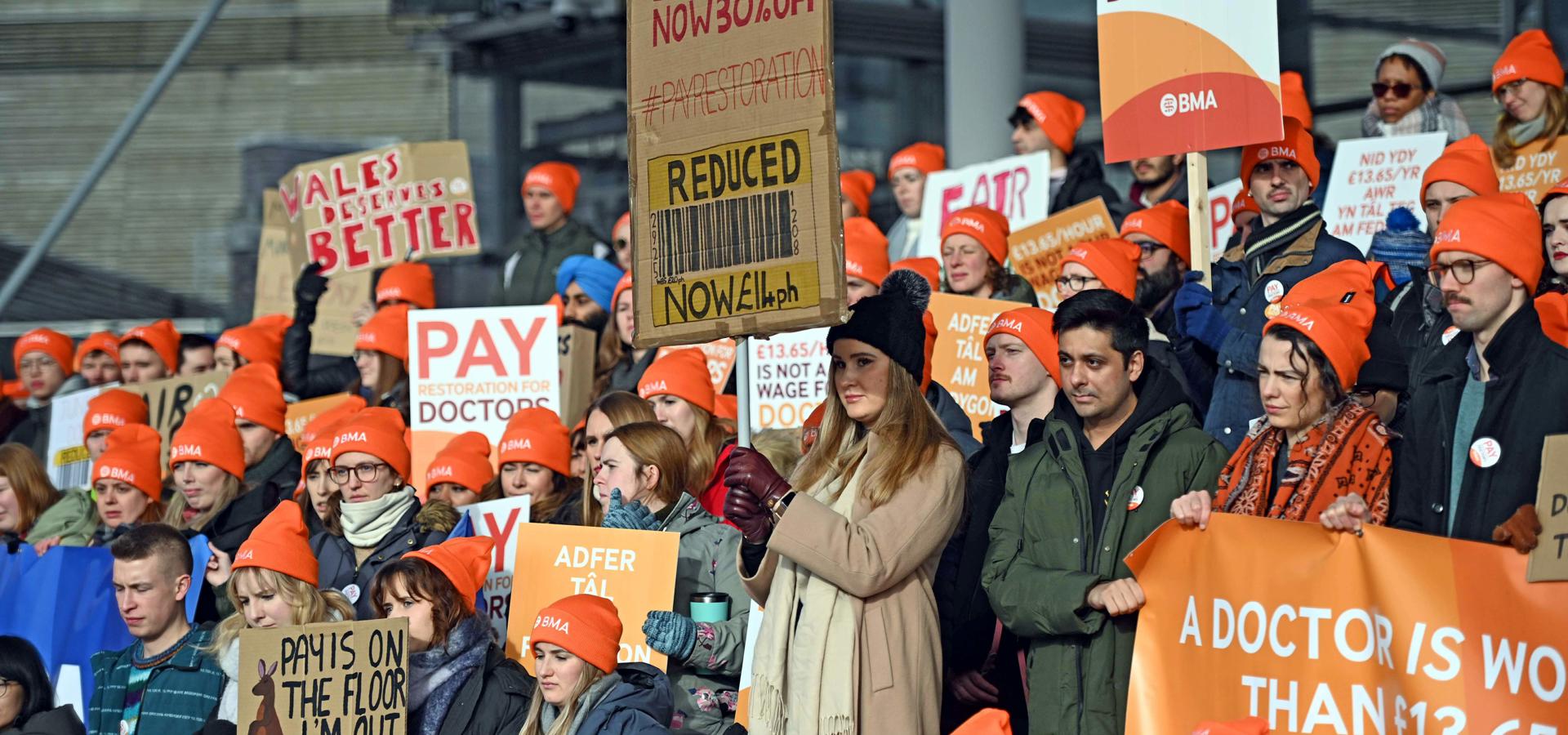
Resident doctors in Wales in dispute over pay and jobs
Earlier this year, the Welsh Government announced it would implement the pay review body’s recommendation for resident doctors of just 3.5%.
Even with the additional investment from contract reform due to be implemented in August, this pay award means that resident doctors in Wales will still have experienced a 15.7% real-terms pay cut since 2008/09. This pay rise makes no progress against pay erosion, and given the latest expectations around inflation, is likely to end up as a real-terms pay cut.
The pay award announcement came after the Government had already announced it would effectively freeze resident doctor training numbers for 2026/27. Despite it having provided a commitment as part of contract reform to understanding and tackling training bottlenecks, the Government still implemented a freeze to funding allocation, which would increase bottlenecks at the Foundation to core transition point. We know that many of us are being turned down for specialty training jobs or are struggling to find locally employed posts. It seems unfathomable that whilst the NHS in Wales remains under extraordinary pressure with long waiting times, that any doctor has concerns about finding a job, let alone progressing their medical career in Wales.
With no other option on the table, we entered dispute Welsh Government over these decisions, writing to the Cabinet Minister in April.
With a new Welsh Government, following the 2026 Senedd election, now in place and a Cabinet Minister for Health and Care announced, we are calling on them to meet with us as soon as possible to address our three simple calls:
- Train doctors by investing in specialty training numbers and tackling training bottlenecks.
- Pay doctors by making a pay award that continues genuine progress towards full pay restoration.
- Retain doctors in the Welsh NHS by improving the conditions that keep doctors working and training in Wales.
We want to work constructively with this Government to resolve our dispute and have already written to the Cabinet Minister to highlight our concerns and request urgent action. However, as we made clear to their predecessor, if progress is not forthcoming, we will seek to ballot you, our members, on whether to take industrial action to resolve this dispute.
Why we are calling for full pay restoration
Since 2008/09, resident doctor pay in Wales has experienced a substantial real terms pay cut after numerous sub inflationary pay uplifts. As shown on the graph below, our strike action over the 2023/24 pay award and investment in contract reform provided meaningful progress towards the restoration of our pay. However, the pay uplift for this year makes no progress against pay erosion, and given the latest expectations around inflation, is likely to end up as a real-terms pay cut. We’ve worked hard to make progress on our journey to full pay restoration and we cannot accept a pay uplift which begins to undo this work.
Jobs for resident doctors in Wales
Last year we wrote to the Cabinet Minister for Health and Social Care highlighting the impending crisis in resident doctor employment and the ongoing uncertainty around job security many of us were facing. We highlighted at the time that the Welsh Government’s failure to accept the recommendations of HEIW’s Education and Training Plan meant there would be insufficient Core, Specialty and GP training posts for those leaving the Foundation Programme in Wales, even without taking into account competition from those outside of Wales. Thank you also to those who responded to our surveys on employment and shared your concerns with us. Your responses painted a stark picture of the difficulties you are facing in accessing training posts and the impact this is having on you both personally as well as professionally.
Despite the Welsh Government’s own commitment to establishing a working group to resolve the bottlenecks issue, for the upcoming training year it chose to maintain its funding allocation, representing a real terms cut to the requirements of the HEIW education and training plan for 2026/27. In doing so, the government ignored HEIW’s clear message in its ETP that the failure to secure additional places would increase bottlenecks at the Foundation to core transition point undermining the working group before its work began in earnest. We need to act now to ensure a sufficient number of training places to meet the needs of the NHS in Wales and ensure job security for every resident doctor in Wales.
Data shows nationally that training places have increased by only 6.4% from 2016 to 2024, yet the number of applications increased by 174% in the same period. In 2025, 33,108 doctors applied for fewer than 10,000 CT1/ST1 specialty training places.
Your WRDC is clear that an increase in training places is vital to reduce the bottlenecks that members across Wales have been impacted by in recent years. Alongside the increase in training places, the Medical Training (Prioritisation) Act (MTPA) 2026, provides a further opportunity to address this issue.
We will be engaging with the development of regulations under the MTPA to ensure that the benefits of this law are maximised, whilst recognising internationally trained doctors who have already gained significant experience of working in the NHS should be considered within the prioritised group in future.
What you can do
Make sure your details are up to date
It’s vital that we have up-to-date contact details so that we can keep you informed about any developments in negotiating with the new Welsh Government and contact you quickly if a ballot for strike action becomes necessary. Staying connected helps us stay organised and maintain the leverage required to secure a positive outcome.
Encourage colleagues to become BMA members
The BMA is an organisation composed of its members. A larger, activist membership makes us stronger together. If a strike ballot becomes necessary, having more members will increase our leverage with the Welsh Government and enable us to fight together for better pay, conditions, and job security.
Join your local negotiating committee
LNCs (local negotiating committees) are local committees of accredited BMA representatives who meet with local management at a joint LNC to raise local issues on behalf of BMA members, negotiate local policies and protect and improve workplace policies, conditions and terms and conditions. Having resident doctors on our LNCs is vital. Find the contact details of your LNC chair to ask about joining.
Become an activist or an active member

Activists
- Represent colleagues and champion local campaigns
- Speak to members and arrange local workplace meetings
- Advocate for colleagues and highlight workplace issues
- Recruit members to increase our collective strength

Active member
- Stay connected and engaged with the BMA without formal accreditation or training
- Provide feedback to the LNC reps on workplace issues
- Share BMA communications and information
- Support campaigns and encourage new members
Our pay campaign so far
2023/24: Delivering change through strike action
Our three rounds of strike action in 2024 forced the Welsh Government back to the negotiating table. After intense negotiations, we were pleased to reach a final deal which 96% of you voted to accept. This deal included an extra 7.4% uplift for all resident doctor pay points, bringing the total pay award for 2023/24 to 12.4%.
This revised pay offer also secured a commitment from the Welsh Government to work with us on agreeing changes to the current study budget and study leave system in Wales, as well as a recommitment to the provisions set out in the NHS Wales fatigue and facilities charter.
We also agreed to re-enter contract negotiations with the Welsh Government, with the ambition of reaching an agreement that would be put to members for implementation in 2025/26. We made it clear that any renegotiation of the rejected 2022 proposals must address the major concerns members raised around pay systems and working hours, and must include appropriate investment.
2024/25: Continuing the path to pay restoration
For the 2024/25 pay year, the Welsh Government announced its acceptance of the pay review body’s (DDRB) recommendations on pay. This meant that resident doctors’ pay increased by 6% + £1,000; an in-year uplift of between 7.6% and 9.3% to our pay. This pay award was above RPI and therefore continued to restore our pay.
In a survey which we launched following the 2024/25 pay award announcement, you told us you were broadly satisfied. Because of this, and the fact that the uplift continued our path to full pay restoration, we felt that the time was right to bank this pay uplift, further build up our organising capacity, and look at securing an improved contract for resident doctors working in Wales which was subsequently accepted by a majority of members.

BMA strike fund - donate now
A strike fund is available to subsidise members in serious financial difficulty who otherwise couldn’t afford to take part in any future rounds of strike action.
The strike fund is supported through voluntary donations to make available to doctors in need.
