
This page will continue to be updated with information about how and when the deal will be implemented.
The UK Government made a revised offer to resolve the dispute over jobs and pay. The UK RDC executive committee voted to call off the strike action that had been scheduled to take place 15 – 19 June. Members subsequently voted to accept the offer in a referendum.
Summary of the offer
Pay
The offer, in combination with DDRB recommendation, offered an average of a 6.6% pay uplift, fully delivered by April 2027. This is out-with the DDRB award for 2027/28, which is to be made on top of the nodal point investment delivered in April 2027.
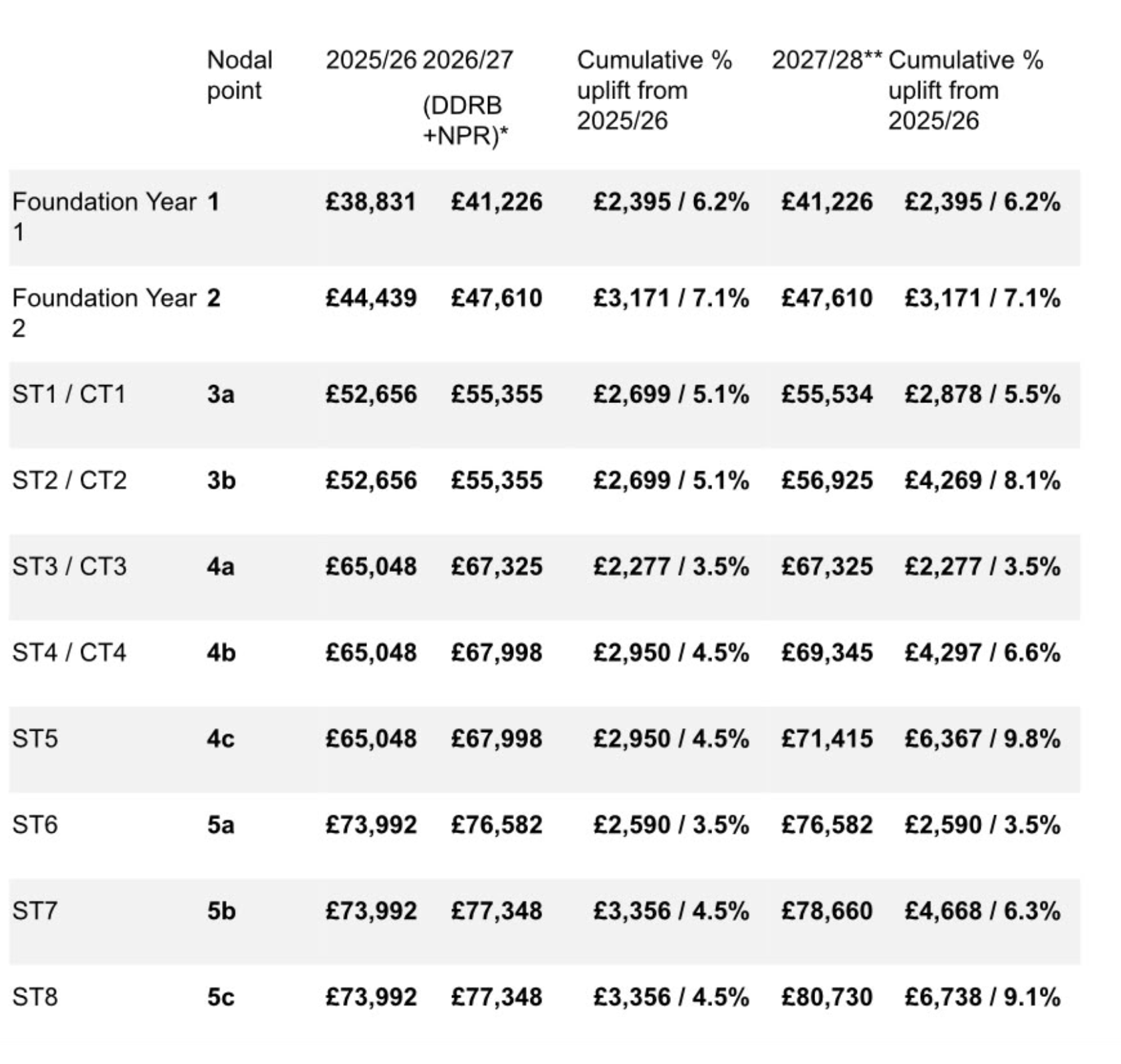
What this means:
All doctors will have received a 3.5% uplift from the 2026 DDRB award, backdated to April 2026. As part of this offer doctors will receive an additional average 3.1% before April 2027, delivered as part of this deal. In addition to these uplifts, the Government has committed to implementing the DDRB recommendation due in April 2027.
All doctors received backdated pay to 1st April 2026 worth an average of 4.9% (DDRB + additional investment into nodal point reform for 2026/27) with the uplifted payscales applied going forward.
Depending on the nodal point, pay increases for doctors from April2026 are between 3.5% and 7.1%, and from April 2027 between [the 2027 DDRB]% and 5.3% plus [the 2027 DDRB]%.
Overall, across the nodal points, this means an average 6.6% uplift delivered before April 2027, in addition to the 2027 DDRB recommendation.
Clinical Academics Flexible Pay Premia
From April 2027, the academic FPP will increase to £10,000 (currently set at £5,614).
Jobs – locally employed doctors
This offer includes 2016 terms and conditions adjusted to remove references to training, as part of a new national contract, being offered to all LEDs.
This offer includes substantive (permanent) contracts for LEDs to ensure job security.
Some additional detail:
New pay protection will be devised for residents who wish to transfer from 2002 terms to 2016 terms.
We have now agreed guidance that sets out how employers shall transition LEDs to substantive contracts (i.e. not short, fixed-term contracts), except where there is a legitimate reason as set out in this guidance (e.g. employing cover for maternity, paternity, or adoption leave, or long-term sickness).
Transition agreements will be managed nationally. LEDs do not need to negotiate changes locally to their contract should they wish to transition. Residents can decide to stay on the 2002 contract if they wish.
Some additional detail:
A number of these jobs will be new national training numbers, a number will be created using repurposed funding from elsewhere (e.g. overspend in agency), and a number of these will be created by LED contracts coming to an end which, will be repurposed.
No LED contracts will be terminated to facilitate conversion.
A distribution group will decide the split of jobs geographically and in which specialties and the BMA will be part of that group (as part of this offer). The group will also consider the distribution of additional specialty training posts in 2027 and 2028 and give the BMA data to protect LEDs.
None of the 4,500 jobs will be in general practice.
There will be a minimum of 4,000 jobs and a maximum of 4,500.
See FAQs for more information on the new training places and core/ higher split.
Exam fees
The first two attempts of each Royal College exam for resident doctors in training and LEDs in England will be funded. These include relevant dental exams for dentists and OMFS trainees. . We have recently worked with the Academy of Medical Royal Colleges (AOMRC) to publish a list of eligible exams. If you believe there is an exam missing from this list that is eligible, please contact the BMA.
Some additional detail
The reimbursement system will go live within the next few weeks, and we will update with the specific date when it is confirmed.
Once the system is live, residents will be able to submit a claim for reimbursement as soon as they have paid for the exam and can evidence this. Residents do not have to have taken the exam. For those who have already taken exams since 1 April 2026, they will also be able to claim reimbursement for these exams and can claim this once the system is live.
For the full list of the exams that can be reimbursed and FAQs, please visit the Academy of Medical Royal Colleges website.
Portfolio fees
Portfolio fees will be covered for doctors in training and for LEDs from April 2027.
Some additional detail:
Portfolio fees incurred from 1 April 2027 will be reimbursed.
Royal College (membership) and faculty fees
Royal College (membership) fees will be covered for doctors in training and for LEDs from April 2027.
Some additional detail:
Where residents require multiple Royal College memberships they will both be covered.
LTFT progression
Less than full-time doctors will have ARCPs set at 12 months by default, with the ability to progress at the same rate as full-time doctors if they meet their competencies. Doctors have the decision to delay this if they do not feel ready to progress.
Some additional detail:
The gold guide already states that competency-based training should be the norm, but many deaneries automatically extend training of LTFT. This will be stopped.
If a LTFT progresses through the nodal points by achieving all of their curriculum competencies, they should CCT at the same time as a full-time doctor.
Future working arrangements
An Industrial Relations Committee (the RDIRC) will be set up to enforce all elements of the offer. The membership will comprise of DHSC, NHS England, NHS Employers and BMA UKRDC.
Some additional detail:
This will ensure we can hold the Government and employers to account on all aspects of terms and conditions (for example recruitment issues or contractual negotiations)
Protecting and renaming the GP flexible pay premia
The GP FPP will be renamed to the General Practice Registrar Enhancement, and it will be separated from the hard to fill section of the pay circular, thereby decoupling it from GP-training fill-rates. It will keep all contractual pay protection and continue to be uplifted in line with DDRB recommendations.
Some additional detail:
This was an ask of the BMA GP Registrars Committee.