

What the BMA is calling for
Across the world, the UK medical degree is recognised for its excellence in teaching and assessment. However, the rapid expansion across UK medical school places without investment in the infrastructure, placement capacity, and educator workforce is jeopardising these high standards. Alongside this, medical students are currently facing significant career uncertainty, with most accumulating high levels of debt, after they become doctors. The current number of medical students far outstrips the number of specialty training places available for them when they qualify, creating a broken pipeline.
The BMA is causing for an immediate pause in the expansion of medical school places until the following two conditions are met:
1. Medical students must have adequate postgraduate places
Sufficient foundation, core and speciality training places with the equivalent post-CCT (Certificate of Completion of Training) employment for all UK medical graduates.
2. Preservation of medical education quality
Educational high-quality undergraduate medical education is guaranteed by ensuring providers have the sufficient infrastructure, teaching capacity, and medical educator workforce to provide medical students with a high-quality education.
Actions the Government should take
To address our concerns, before any further medical school expansion, the government must:
1. Ensure the Medical Training (Prioritisation) Act 2026 remains effective as an urgent measure to reduce competition ratios:
Any regulations made under the Act must aim to maintain competition ratios for UK graduates below 2. You can read UKMSC’s latest update here.
2. Guarantee foundation programme posts:
Give a permanent guarantee that all UK graduates will be offered a foundation programme post and not be allocated a placeholder.
3. Expand training placements and employment:
Expand core and speciality training with the equivalent post-CCT employment to ensure all UK medical graduates have a reasonable chance of becoming the GPs and the consultants of the future.
4. Reverse the decline in medical academics:
Implement funding to reverse the decline in tenured medical academic posts, establish pathways for the development of the future professional educator workforce, and address financial incentives associated with this career path to ensure demand for high-quality medical educators meets supply.
5. Robustly monitor placement capacity and educational delivery:
Both placement providers and medical schools should monitor, with defined thresholds that trigger action where standards are no longer met. This should include accountability of where funding for undergraduate education is spent and uplifts in the educational tariffs
What the BMA is doing
This is a UK–wide issue, and we are working proactively to highlight the problems medical students alongside the educator workforce are facing. We are also engaging with key stakeholders across the UK:
In England
-
We have written to the minister of state for health demanding a pause in medical school expansion
In Scotland
- BMA Scotland has run a national survey of over 500 medical students across Scottish medical schools at all stages of training. In March 2026 published its report: “Beyond Capacity: The Impact of Increased Medical Student Intake in Scotland”
- We are discussing this issue with the Scottish government and other key stakeholders.
How can you help (medical students)
- Join the BMA – the more students who are BMA members, the better we can represent you.
- Share our campaign and discuss it with your colleagues. If you have specific issues at your medical school, contact your local rep today.
- Fill in our reporting tool: If your education has been affected by a lack of investment in teachings or other problems related to medical school expansion, please report it via our reporting tool.
Background: the problem with medical school expansion
The BMA is concerned the rapid expansion, without adequate investment the educational estate and teaching capacity, risks reducing the educational experience of medical students, alongside the real risk of unemployment within a couple of years of graduation due to inadequate postgraduate training posts. Without a corresponding increase in training places, competition ratios for existing places will only increase leading to many students being locked out from working as doctors. Similarly, without an increase in medical academic staffing across the UK, expansion risks diluting the well-regarded standard of medical education available in the UK.
The BMA continues to recognise that the quality of medical schools graduating from UK medical schools remains high. The UK medical degree (known as the primary medical qualification) is considered worldwide to be a high-quality degree, in terms of teaching and assessment. The BMA recognises that the UK is under-doctored. However, for too long successive governments across the UK have taken the political expedient option of expanding medical school places, without the required infrastructure or workforce planning, which risks the future ability to train specialist doctors.
What is high quality medical education and why is it important?
Doctors undertake the longest and most in-depth training pathway of any healthcare professional. This breadth and depth of training is essential as our population ages and becomes more medically complex. The BMA are clear that doctors must not be replaced by other healthcare professionals ‘training to task’. However, training doctors requires significant resources, and we must ensure there are sufficient infrastructure, medical academics and clinical educators to teach medical schools before we can expand medical school places.
Expansion of medical school places
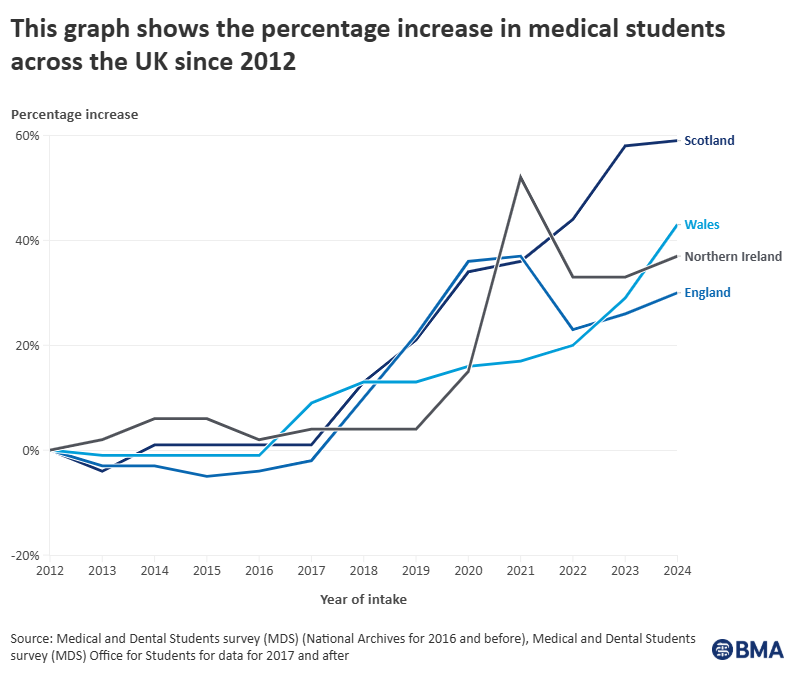
Medical school intakes have increased significantly over the last decade, with intake numbers increasing by 39% between 2013 and 2024. Expansion has occurred across the UK with the most significant expansion occurring in Scotland.
Graph 1: Rising medical school intake by nation and across the UK
The number of medical schools has also significantly increased from 33 to 49 from 2013 to 2025 with three more scheduled to open in the next two years.
Risk of doctor unemployment
Despite the increase in medical school numbers, the expansion of speciality training places has not kept pace with posts being fairly static.
Graph 2: Relatively static supply of training places

The expansion of medical school places, alongside the increase in IMGs applying to speciality training after the removal of the resident labour market test has led to significant speciality training bottlenecks. The Medical Training (Prioritisation) Act 2026 is a vital first step, but this will not be sufficient to address the bottlenecks. In 2026, over 40,000 applicants applied for approximately 11,000 posts.
The lack of planning contributes to significant training bottlenecks and risks doctor unemployment. BMA survey data showed 52% of FY2 doctors in England responding to a BMA survey in August 2025 had not secured employment and UKFPO career destination survey data showed the number of responding FY2s seeking employment doubled from 9.1% to 17.4%. For medical students this has led to the significant concern of unemployment. Medical students today are graduating with significantly higher levels of debt compared to previous generations.
Impact on educational quality
From medical students, we have heard anecdotal concerns about how increased class sizes are affecting the quality of education. UK medical education is respected around the world for its quality however, medical school expansion without the required infrastructure and investment threatens this. If this continues, we risk undermining the educational quality for medical students.
Medicine, like many other professions, depends on qualified doctors educating the next generation of doctors. However, the expert educator – medical academic – workforce is at significant risk. While medical student numbers in the UK have risen sharply, the medical academic workforce has not. National data show that the number of medical academics has remained broadly unchanged for around two decades, leaving similar academic staffing levels to those seen in the mid-2000s, despite a substantially larger student population.
This mismatch has direct consequences for education quality. Medical academics play a central role in teaching, supervision, curriculum leadership, and the integration of research into clinical practice. Stagnant academic capacity, combined with an ageing workforce and approaching retirements, raising further concerns about maintaining educational quality and ensuring students have access to important opportunities (such as research exposure) which enrich the curriculum. This has led to medical academics working flat-out to ensure students continue to graduate with the rigorous standards set by the General Medical Council to ensure they are fit-to-practice. However, without investment in our medical academic workforce, this will not be sustainable.
We also know the impacts of expansion on educational quality are felt outside of the university, as demands on doctors responsible for training students and residents grow. According to the GMC’s most recent National Training Survey, 29% of secondary care trainers and 18% of GP trainers said they weren’t always able to use their allocated training time specifically for training purposes. 29% of secondary care trainers said their trainee’s education and training negatively affected by rota gaps being dealt inappropriately, and 47% of trainers are at moderate or high risk of burnout.